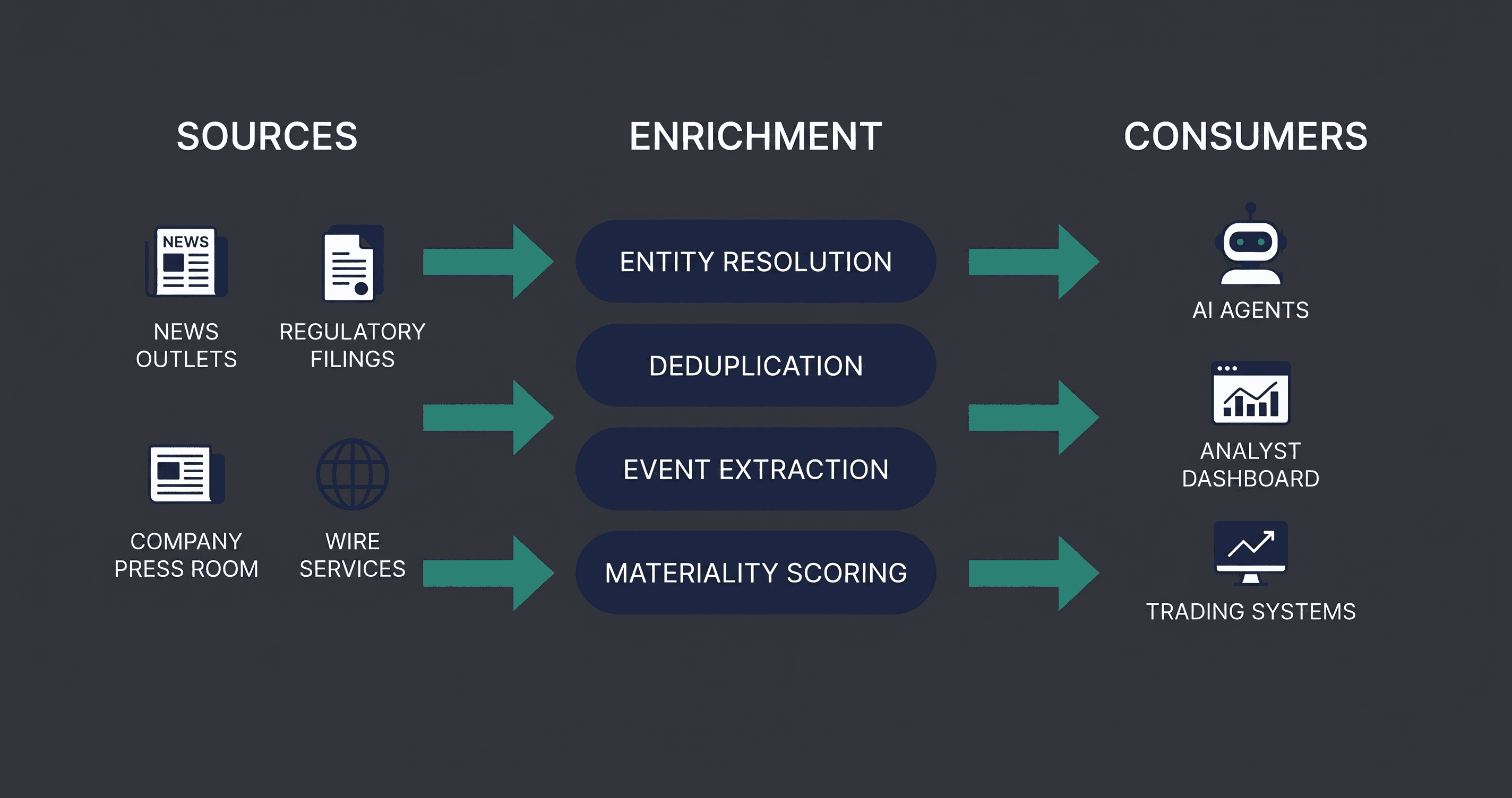
Every business news API on the market sells itself on coverage. Coverage is the wrong axis.
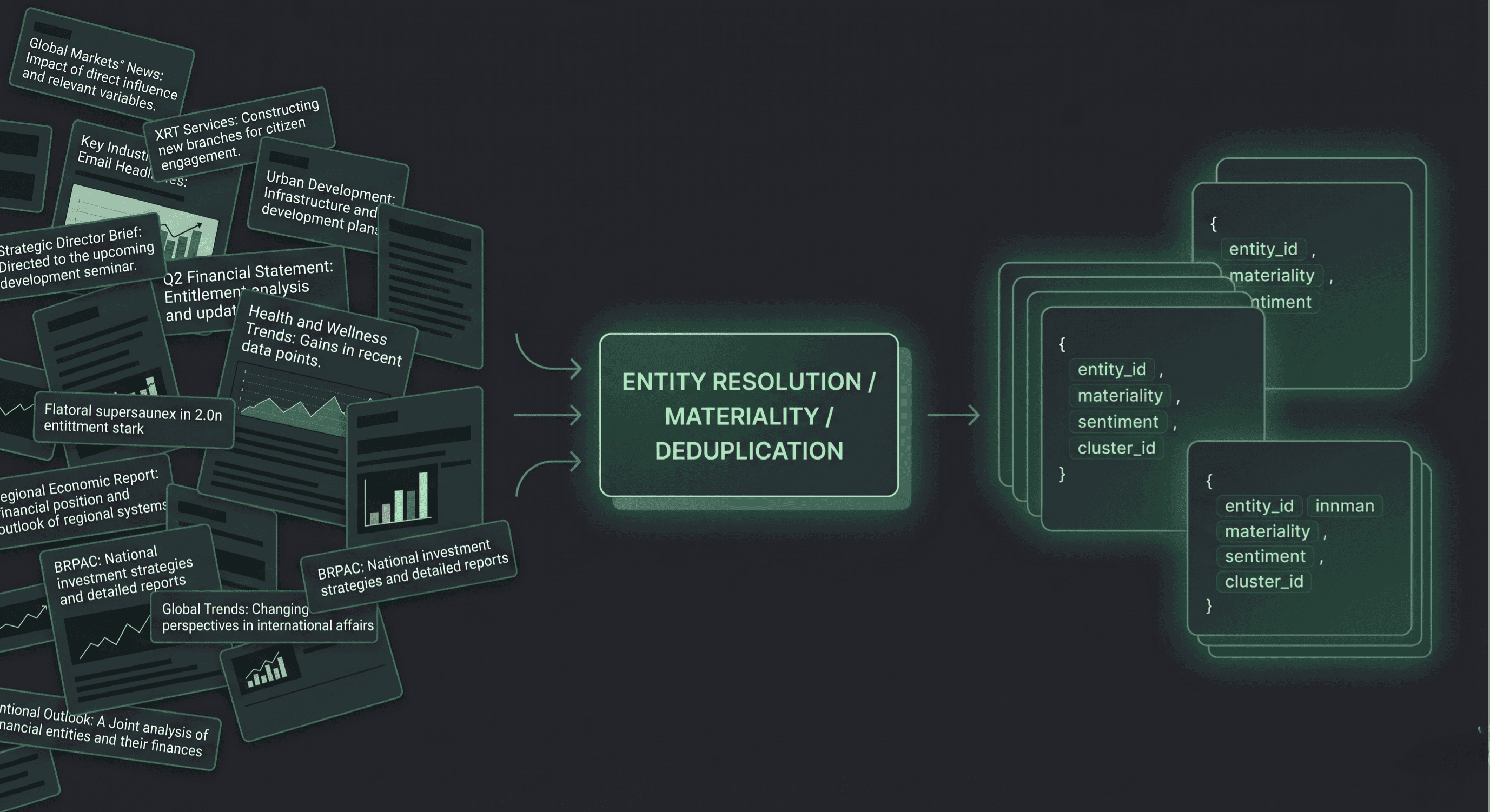
The thing that actually breaks production systems is the gap between a headline and a usable signal: deduplication that holds across wire services, entity resolution that survives a rename or an acquisition, materiality scoring that an agent can act on without a human in the loop. According to Fortune Business Insights (2026), the AI agents market grew from $8.03B in 2025 to a projected $11.78B in 2026 and $251B by 2034. Those agents are reading news at a scale humans never did, and most of the APIs they read from were designed for human dashboards.
This guide is for the people choosing what to build on. It is not a "top 10" list. It is a decision framework: how the business news API category is actually segmented in 2026, what to evaluate, how to test, and where the real cost lives once you scale past the free tier.
What a business news API actually does
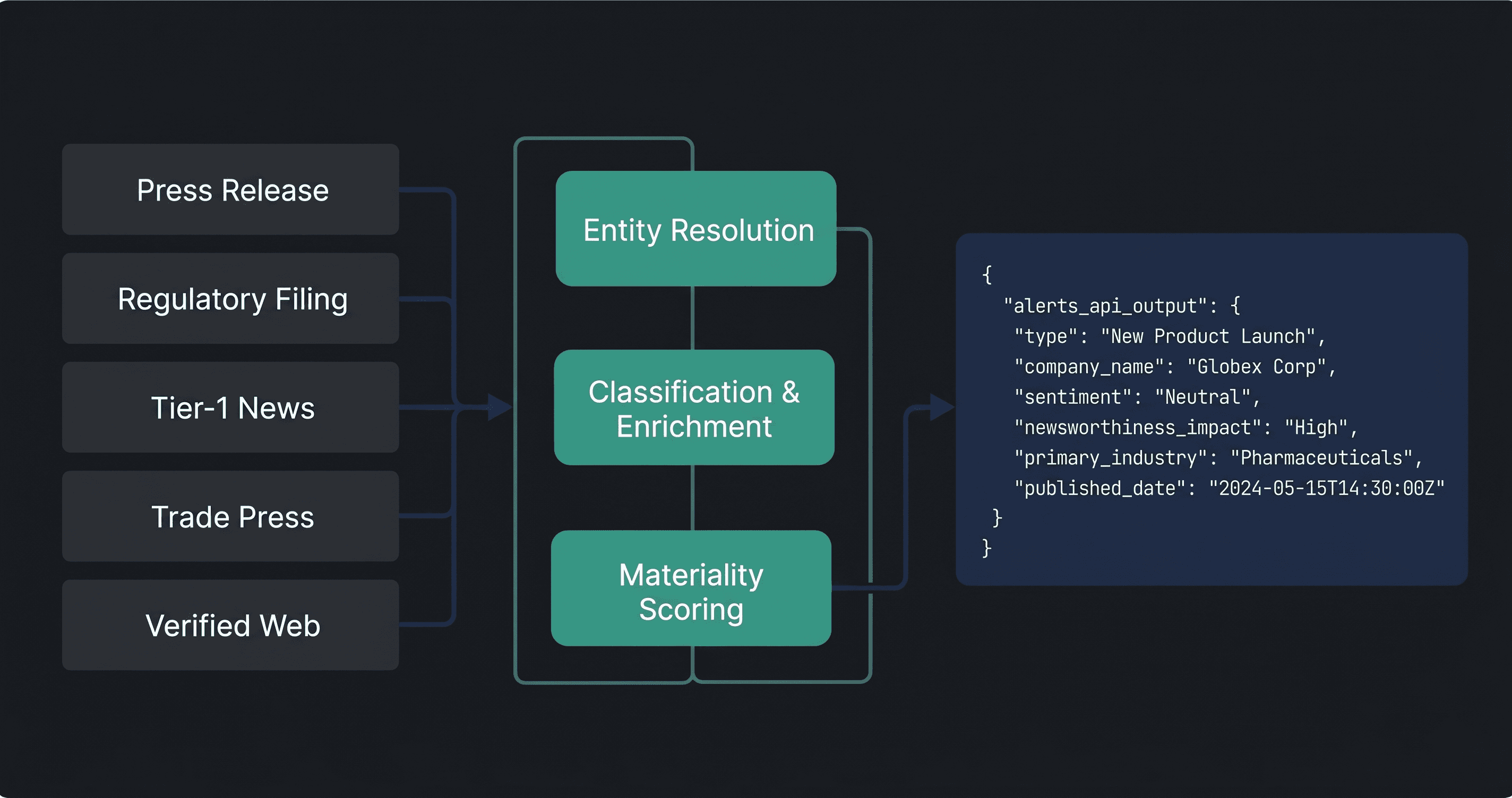
A business news API is a programmatic interface that returns business-relevant news content, including company press releases, regulatory filings, earnings coverage, M&A reporting, and industry news, in a structured format (typically JSON over REST or via webhook). Modern APIs in this category enrich each article with metadata such as resolved company entities, sentiment, topic tags, and event classifications, so downstream applications, including AI agents and analytics dashboards, can act on the data without first parsing prose.
That definition matters because three different products are sold under the same label. A generic news endpoint that returns headlines tagged with category=business is not the same product as a company-resolved feed that returns a structured event whenever a portfolio holding files an 8-K. Both call themselves "business news APIs." Only one ships agent-usable signals.
Why the category is fragmenting in 2026
For the last decade, "news API" mostly meant a thin layer over RSS and a search index. The fragmentation started when AI agents arrived as customers.
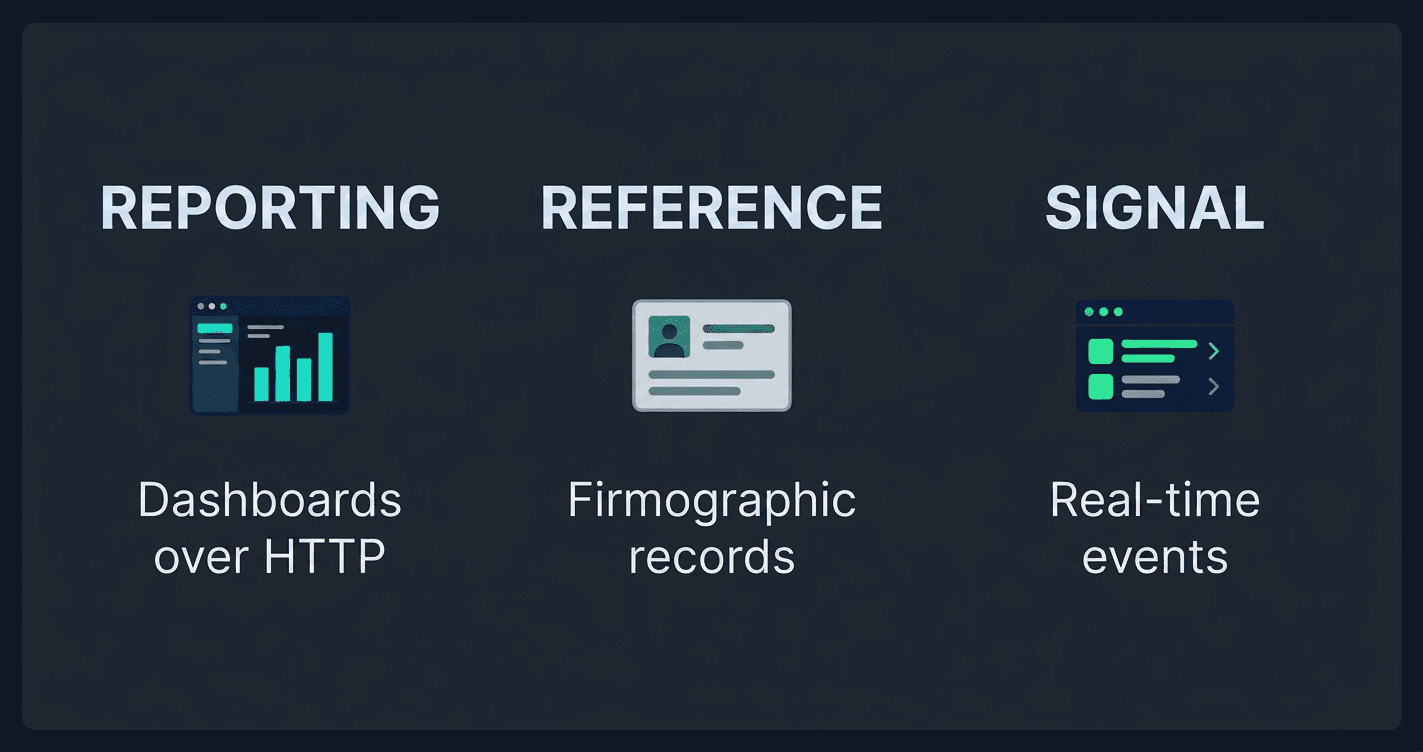
According to Gartner, by 2026 more than 30% of the growth in API demand will come from LLM-based tools, not human-driven applications. Postman's developer base reached 35 million by 2026, and a meaningful share of new integrations target agent workflows rather than dashboards. The shift forced news APIs into three lanes that used to overlap quietly:
Human consumption. Cheap, broad, optimized for displaying headlines in apps and feeds. Coverage is the headline metric.
Quant and market data. Tightly coupled to tickers, optimized for low latency and clean ticker mapping. Used for trading, alpha generation, and intraday risk.
Agentic and analyst workflows. Optimized for entity resolution, deduplication, materiality, and event extraction. Used for due diligence, monitoring, competitive intelligence, and any AI agent that has to decide before it acts.
Pricing reflects the split. A general news API with 150,000 sources will charge a fraction of what a structured business news API with resolved entities and event classifications charges, because the second product does the work the first product offloads onto your engineering team.
The five evaluation axes that actually matter
Most buyer's guides list ten features. Five of them carry the decision in practice. Rank these against your use case before you read another vendor page.
1. Coverage that matches your universe, not the vendor's brochure
"150,000 sources" sounds impressive until you realize 90% of them are general-interest publications and you cover mid-market industrials in Germany. Ask three concrete questions:
Does the API index the regulatory portals, trade publications, and regional outlets that move your names? German Federal Gazette filings matter to a DACH-focused fund. Japanese EDINET filings matter to anyone trading Tokyo-listed equities.
How deep is non-English coverage? Marketaux indexes 5,000+ sources across 30+ languages. Contify advertises 250,000+ non-English sources, auto-translated. NewsAPI.org tops out at 14 languages.
Does the API include first-party sources (company press rooms, IR pages, SEC EDGAR, central bank releases) alongside news media? For corporate development and risk teams, missing a primary source is worse than missing a wire pickup.
The number of sources is a vanity metric. The composition of those sources is the actual coverage story.
2. Entity resolution (the hidden killer)
This is where most integrations die six months in. Entity resolution is the system that decides whether a headline about "Meta," "Meta Platforms," "FB" (the old ticker), "Facebook" (the old name), and "Instagram" (a subsidiary brand) should all flow into the same company record.
The failure modes are predictable and expensive:
A portfolio company gets acquired and renamed. Your monitoring stops firing because the new name was never linked to the old
company_id.A target files under a holding company name on a regulatory portal, then issues the press release under its operating brand. Your agent sees two unrelated events when it should see one.
A foreign subsidiary trades under a localized name that the news API does not link to the parent.
The Akta platform resolves across more than 20 million parent companies, subsidiaries, and trading names (Akta, 2026), which is the kind of detail that does not show up on a comparison table but determines whether your application actually works in production. When evaluating an API, run a deliberate test: pick three companies that have changed names, ticker symbols, or jurisdiction in the last 24 months. See whether the API still returns continuous coverage.
3. Structure and enrichment
A business news API returns more than text. The enrichment fields decide what an agent can do without a human reviewing the output.
The fields that matter:
Resolved entities with stable IDs (not just inline name strings)
Sentiment, scored at the article and entity level, since the sentiment toward Apple in a story about supplier earnings is not the same as the sentiment toward the supplier
Topic and event classifications (earnings, M&A, litigation, leadership change, layoffs, product launch, regulatory action)
Materiality or newsworthiness scoring, which tells your agent whether to act now, log, or ignore
Deduplication clusters, so a single corporate event surfaces as one story rather than 47 wire pickups
Finlight, Contify, Akta, and NewsAPI.ai compete on this layer. Generic providers like NewsAPI.org and TheNewsAPI surface raw text with minimal enrichment, which is fine for a feed display and a problem for an agent.
4. Latency and delivery model
Latency is a workload question, not a marketing claim. There are three delivery patterns:
REST polling. Simple, predictable, fine for batch analytics and most analyst workflows.
Webhooks. Event-driven push to your endpoint when matching news appears. The right pattern for alerting and most agent workflows.
Streaming (WebSocket). Sub-second delivery for trading and real-time risk. Finlight, Polygon, and a handful of others operate at this tier.
If you are building a high-frequency trading system, latency dominates. If you are building an investment research agent or a competitive intelligence tool, end-to-end retrieval reliability matters more than shaving milliseconds off the feed.
5. Licensing, provenance, and audit trail
This is the axis that gets ignored until legal asks a question.
Many business news APIs operate on aggregated content under arrangements that restrict redistribution, AI training, or commercial republication. Industry Dive's DiveAccess explicitly prohibits using its content to train AI/ML models and requires citation in any generated output. NewsAPI.org's terms differ from Contify's, which differ from a wire-licensed provider like Dow Jones DNA.
If your downstream system is an internal copilot used by a hundred analysts, your license needs are different from those of a public-facing chatbot. Ask vendors three things:
Can your customers see the output, or is it for internal use only?
Is training models on the corpus allowed, restricted, or forbidden?
Does the API return source attribution that survives the agent pipeline?
A clean audit trail is also a regulatory requirement in financial services. Under MiFID II and the SEC's market abuse rules, any system that informs trading decisions needs to evidence what data it consumed and when.
The four categories of business news APIs
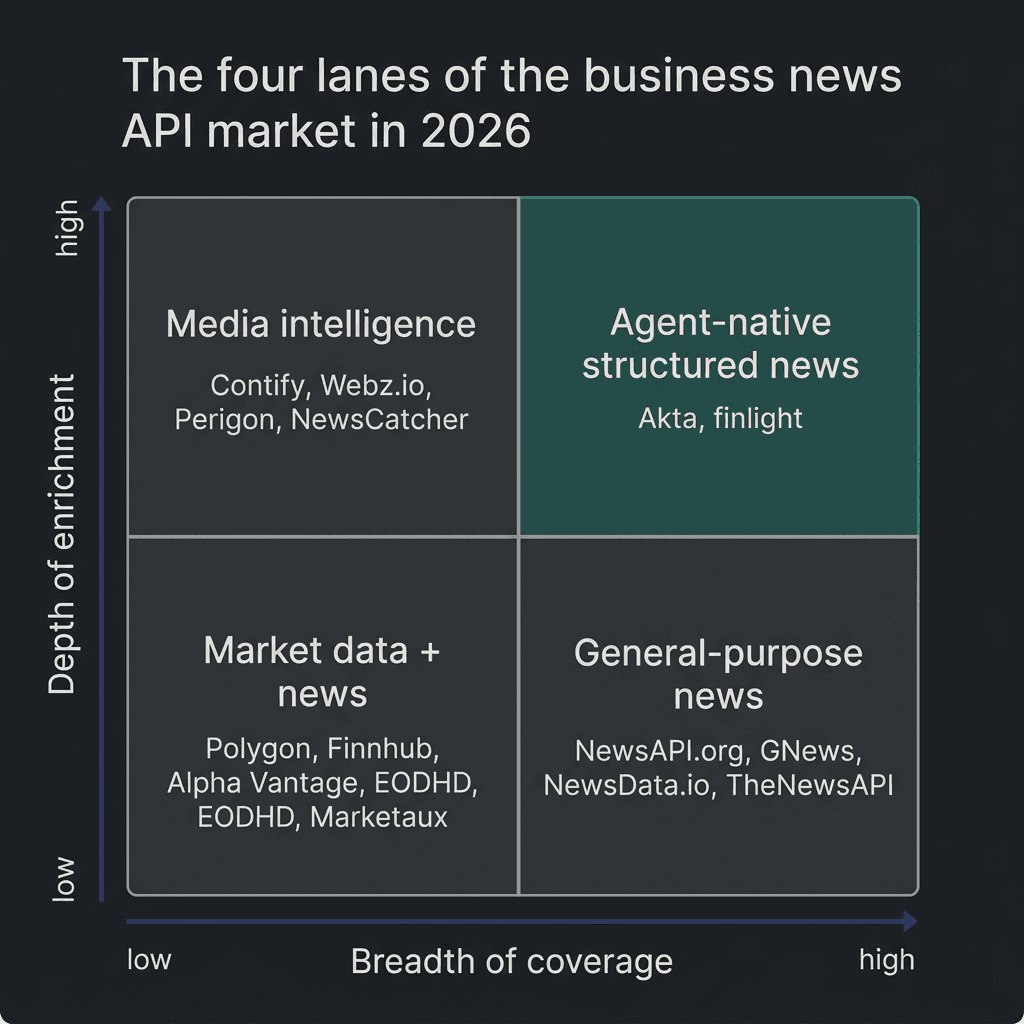
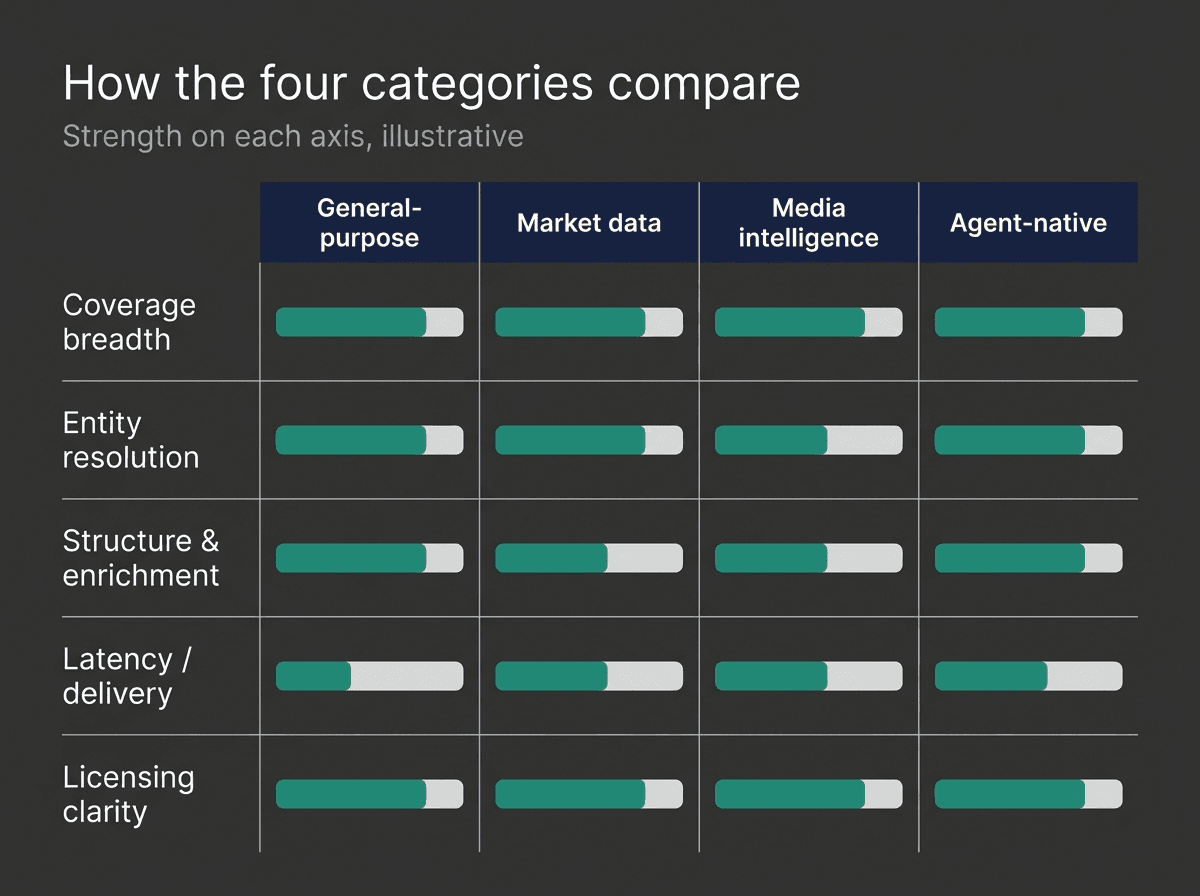
The market collapses neatly into four buckets once you accept that "business news API" is a category, not a product.
General-purpose news APIs. NewsAPI.org, GNews, NewsData.io, TheNewsAPI, Mediastack. Broad coverage, low price, minimal enrichment. Right answer for content discovery, news widgets, and lightweight research tools. Wrong answer for any system that needs to act on what it reads.
Financial market data APIs with news endpoints. Alpha Vantage, Polygon, Finnhub, Tiingo, EODHD, Marketaux. News is bundled with quotes, fundamentals, and technicals. Tightly mapped to tickers, often with sentiment scoring tuned for trading. Right answer for retail trading platforms, quant research, and dashboards that need price and news in the same call. Less useful for private companies, pre-IPO targets, or workflows that need depth beyond a ticker symbol.
Media intelligence and competitive intelligence APIs. Contify, Webz.io, NewsCatcher, Perigon, NewsAPI.ai, Industry Dive DiveAccess, LexisNexis Nexis Data+. Built for monitoring, brand tracking, and market intelligence. Strong on filtering, taxonomy, and multilingual coverage. The traditional home for corporate comms, PR analytics, and market research.
Agent-native structured news APIs. Akta, finlight, and a small set of newer entrants. Built specifically for AI agents and analytical workflows. Strong on entity resolution, event extraction, materiality scoring, and deduplication. Designed so an agent can call once, decide, and act without a human cleanup pass. This is the youngest category and the one growing fastest as the agent market scales.
The categories are not strictly exclusive. EODHD, for instance, ships an MCP server and 72 endpoint-level skills for agent integration, putting it adjacent to the agent-native lane. Akta resolves across public and private companies, which puts it adjacent to the competitive intelligence lane. The boundaries blur where the underlying product capabilities overlap.
Where the real cost lives
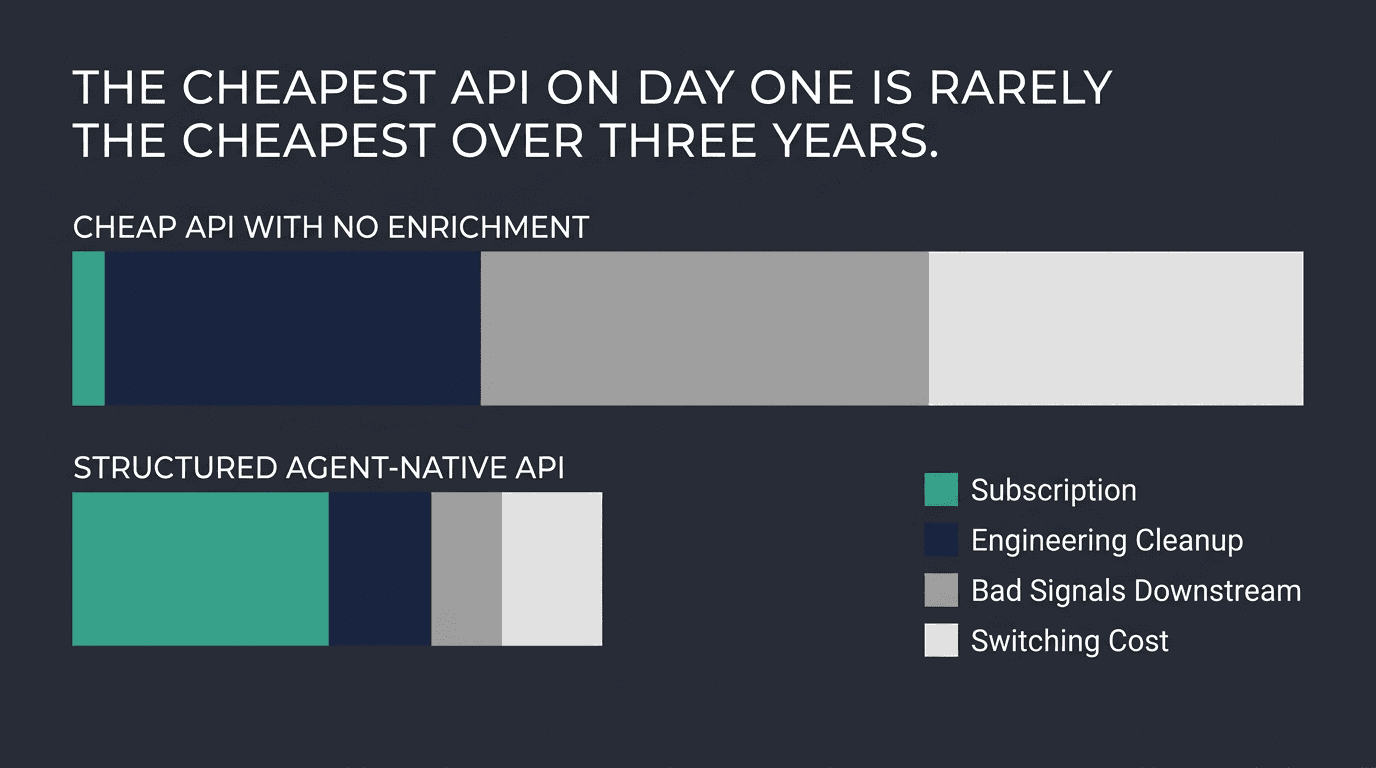
The sticker price of a business news API is rarely the largest cost.
Three hidden line items dominate total cost of ownership:
Engineering cleanup. If the API does not deduplicate, you build deduplication. If it does not resolve entities, you build a resolver. McKinsey's 2024 work on AI in financial services found that data preparation consumed roughly 60% of the engineering effort in production AI pipelines (McKinsey, 2024). Every capability the API offloads is engineering you do not have to staff.
Bad signals downstream. A noisy or unresolved feed produces false positives. False positives waste analyst time, train agents on garbage, and erode trust in the system. The cost surfaces months later, when the model gets paused for review.
Lock-in and switching cost. Once your stack depends on a specific schema, replacing the API is a quarter-long project. The cheapest API on day one is often the most expensive one over three years.
For teams running AI agents at scale, the calculation flips. An MIT study cited by Nordic APIs (2025) found that 95% of enterprise generative AI pilots failed to demonstrate ROI. The pilots that succeed disproportionately invest in clean data infrastructure upstream rather than larger models downstream. A structured business news API is one of those upstream investments.
What to ask vendors (questions most teams forget)
When you take demos, hold the conversation to questions that surface real capability rather than marketing claims:
Show me how the API handles a name change. Pick one from the last 12 months.
What is the cluster size on a major M&A announcement? How is the canonical story chosen?
What's the lag between publication on the original source and availability in the API? Show p50, p95, and p99.
Can I retrieve historical news for a private company with stable IDs that survive a future rename?
Is materiality scored, and if so, against what reference distribution?
What happens if I query a company that has just IPO'd this morning?
Are there licensing restrictions that would prevent me from feeding this into an LLM-powered product?
What's the rate limit, and what does throttling look like in practice?
Vendors who can answer these crisply have shipped the product. Vendors who pivot to coverage and source counts are selling a brochure.
What changes in 2026
Three shifts are already in motion and worth pricing into a multi-year decision.
Model Context Protocol is becoming a baseline expectation. Alpha Vantage, EODHD, and finlight already publish MCP servers. By the end of 2026, an API without an MCP layer will look like an API without OpenAPI specs looked in 2022.
Materiality scoring becomes table stakes. Agents need to triage at machine speed. APIs that return raw streams without prioritization will get filtered through a second-pass scoring layer that competing APIs already include.
Private company coverage moves to parity with public company coverage. Most APIs were built for listed equities. The fastest-growing buyer segment, private capital markets and corporate development, needs continuous coverage on portfolio companies that have no ticker and no SEC filings. The APIs that handle private entity resolution well will absorb that demand. The ones that do not will keep their public-equity niche.
The teams making three-year decisions today should weigh the trajectory, not the 2026 feature list.
FAQ
What is the best business news API?
There is no single best business news API; the right choice depends on what you are building. For dashboards and content discovery, general-purpose APIs like NewsAPI.org or GNews are sufficient. For ticker-mapped trading systems, market data APIs like Polygon, Finnhub, or Alpha Vantage are stronger fits. For AI agents and investment research workflows that need entity resolution, materiality scoring, and structured events, agent-native APIs like Akta and finlight are built for that workload.
Is there a free business news API?
Yes. NewsAPI.org, GNews, NewsData.io, TheNewsAPI, Marketaux, and Finnhub all offer free tiers, typically capped at 100 to 500 requests per day with delayed data and limited historical access. Free tiers are useful for prototyping and learning. They are not suitable for production workloads, which require higher rate limits, real-time delivery, and stronger SLAs (Postman API Report, 2025).
How is a business news API different from a general news API?
A business news API filters and structures content for business-relevant signals, including company announcements, regulatory filings, earnings, M&A, and industry developments. A general news API returns broad news across categories like politics, sports, and entertainment with business as one tag. The difference shows up in coverage of primary sources (IR pages, regulatory portals), entity resolution quality, and enrichment fields like event classification and materiality scoring.
Can a business news API be used for trading?
Yes, with conditions. For high-frequency trading, latency below 100 milliseconds is typical, which narrows the field to streaming providers like finlight, Polygon, and Bloomberg's BPipe. For systematic and discretionary strategies with intraday or daily horizons, broader business news APIs work well when paired with sentiment scoring, event extraction, and reliable ticker mapping. Trading workflows also require audit trails to satisfy MiFID II and SEC market abuse rules.
Do business news APIs work with AI agents?
Most do at a basic level via REST endpoints. The question is whether the API was designed for agents. Agent-native APIs return resolved entities, deduplicated clusters, and scored events, which lets an agent decide and act without a human cleanup step. APIs designed for human dashboards push that cleanup work onto the agent's prompt or the engineering team. As of early 2026, several vendors have shipped MCP servers (Alpha Vantage, EODHD, finlight) to make agent integration faster.
How much does a business news API cost?
Pricing ranges from free tiers for prototyping to $5,000 or more per month for enterprise plans with full historical access, real-time delivery, and high rate limits. General-purpose APIs are at the lower end. Specialized agentic and competitive intelligence APIs price higher because they ship enrichment and entity resolution that would otherwise be built in-house. Total cost of ownership includes engineering time to deduplicate, resolve, and enrich, which often exceeds the subscription fee for the cheaper APIs.
What to do next
If you are early in your evaluation, run the test in the "How to test" section against two or three vendors covering different categories. The differences will tell you more than any pricing page.
If you are building for an AI agent or analyst workflow specifically, the Akta company news endpoint is designed for that workload, with entity resolution across 20M+ companies, materiality scoring, and event extraction in the response payload.
The category will keep fragmenting. The teams that pick on what the API actually does, not on what the brochure says, will not have to switch in 18 months.