Most teams find out a target company changed names, raised a round, or replaced its CEO from a stale Salesforce field, a Slack screenshot, or a Google Alert that arrived nine hours late. None of that scales past a few hundred accounts. A Company Alerts API does.
A Company Alerts API is a programmatic endpoint that delivers structured, real-time notifications about business events at named companies. Triggers include funding rounds, M&A, leadership changes, layoffs, regulatory filings, product launches, lawsuits, and material news. Each event is entity-resolved, classified, and enriched, so downstream systems and AI agents can act on the signal without parsing free-form text.
If you are building sales intelligence, risk monitoring, deal sourcing, or any agentic workflow that needs to know what just happened to a company, this is the layer that decides whether the rest of your stack works. The rest of this guide covers what the category actually contains, where most APIs break, and how to evaluate one when the product behind it has to support both humans and agents.
Why the old company alerts model is breaking in 2026
Company alerting was built for the inbox. The 2010s shape was simple: a user typed in a list of company names, the service pulled press releases and headlines, and a daily email landed at 6 AM. That worked when the consumer was a human reading 30 alerts a day.
The consumer changed. According to Gartner's 2024 B2B buyer survey, 61% of B2B buyers prefer a rep-free buying experience and 73% actively avoid suppliers who send irrelevant outreach (Gartner, 2025). Generic alert digests now produce the exact pattern buyers reject: stale, untargeted, and disconnected from what the receiving team can act on.
At the same time, AI agents started doing the reading. An outbound agent that researches 4,000 accounts per week cannot consume HTML email. A deal-sourcing agent that ranks a pipeline of 250 private targets cannot use a CSV uploaded yesterday. A compliance agent that monitors counterparty exposure across a portfolio of 600 entities cannot tolerate a six-hour SLA on a sanctions update.
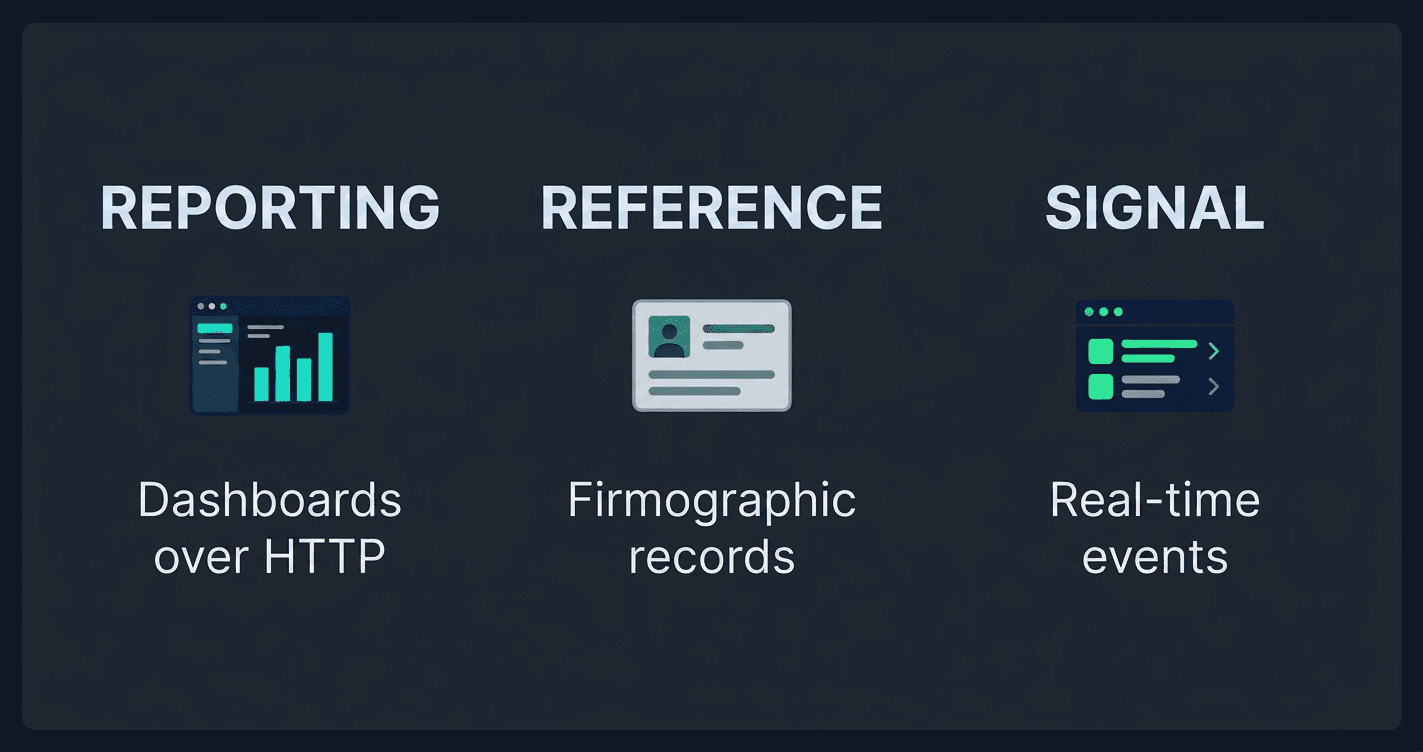
The artifact these agents need is the opposite of an inbox alert. It is a typed, scored, deduplicated event that can be retrieved over HTTP, ranked by relevance, and routed into a workflow that takes an action. That artifact is what a modern Company Alerts API produces.
What a Company Alerts API actually delivers
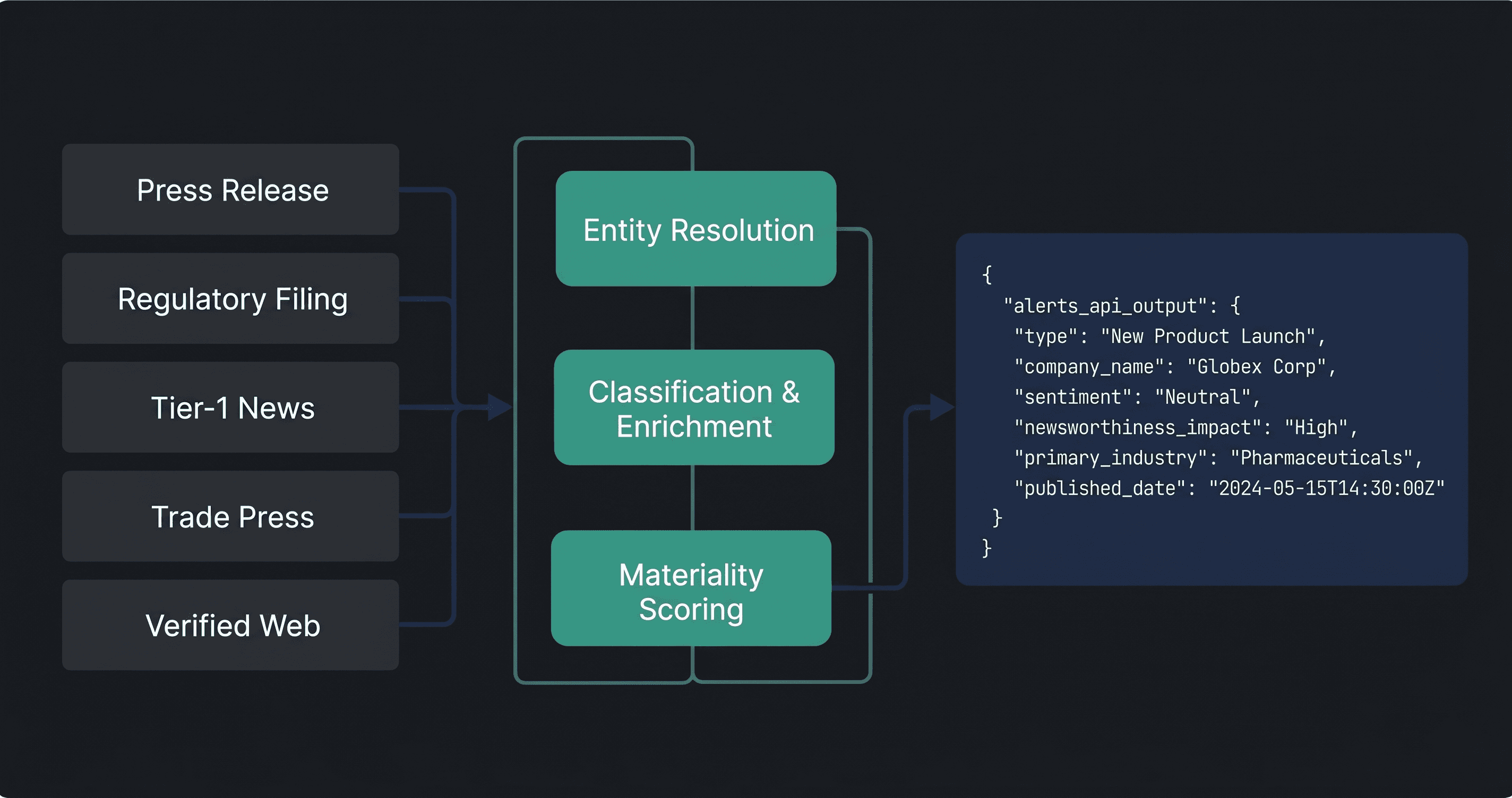
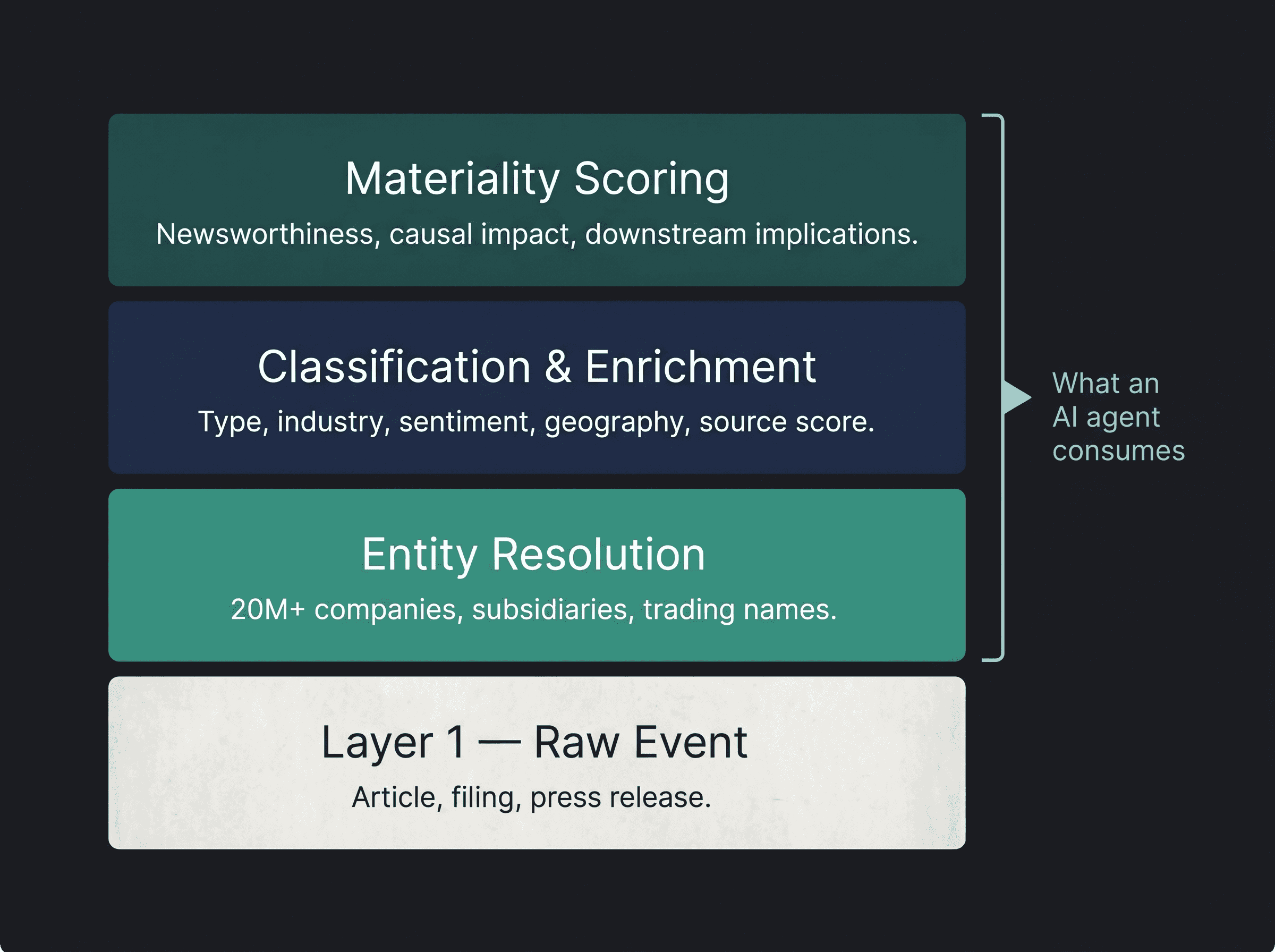
A complete Company Alerts API covers four data layers. Vendors that ship only the first one are news APIs with notification wrappers. Vendors that ship all four are the ones AI teams build on.
1. The event itself
The raw object: an article, press release, regulatory filing, or social/web mention that triggered the alert. This is the minimum, and most legacy news APIs stop here. The payload typically contains a title, URL, publisher, published_date, and a body or summary. Without the layers below, the consumer team is still doing the parsing.
2. Entity resolution
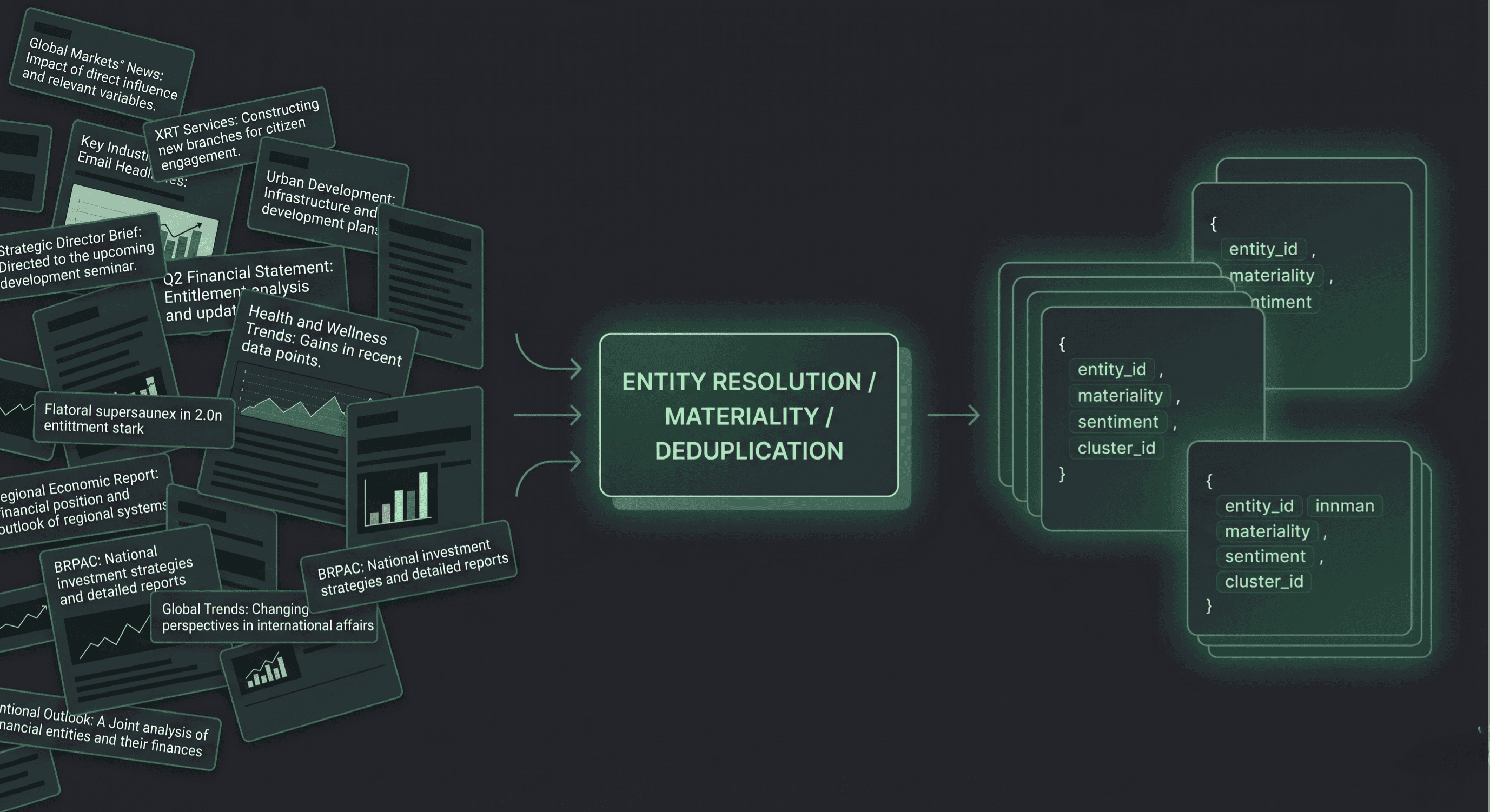
Every event must be unambiguously linked to a canonical company identifier. This is where most APIs fail in production. A single private company can appear in press as "Stripe," "Stripe, Inc.," "Stripe Payments Europe," and "Stripe Bridge"; a target may also share a name with three unrelated entities. Akta's entity resolution covers 20M+ parent companies, subsidiaries, trading names and namesakes (Akta, 2026) so that "ACME Robotics India Pvt. Ltd." and "ACME Robotics" map to one company record rather than two.
3. Event classification and enrichment
Every alert needs structured metadata that an agent can filter on without reading the body:
Event type (M&A, funding, leadership change, layoff, regulatory action, product launch, lawsuit, partnership, secondary transaction)
Industry tags (primary and secondary)
Geographic tags (country, region)
Sentiment (positive, negative, neutral)
Source score (credibility of the publisher)
Original language (for global feeds)
This is the layer that lets a downstream system write a single rule like "alert me on negative regulatory events at financial services counterparties in the EU" instead of a heuristic over body text.
4. Materiality and impact scoring
The hardest layer, and the one most providers skip. Two M&A headlines about the same company in the same week may have radically different consequences. A "newsworthiness impact" score, plus enrichment that estimates downstream effects (supply chain, comp set, sector), is what makes the alert usable for a trader, a deal team, or a risk model rather than a dashboard. Materiality scoring, causal impact assessment, and downstream implication modeling are part of what separates production-grade Company Alerts APIs from headline relayers.
How a Company Alerts API works under the hood
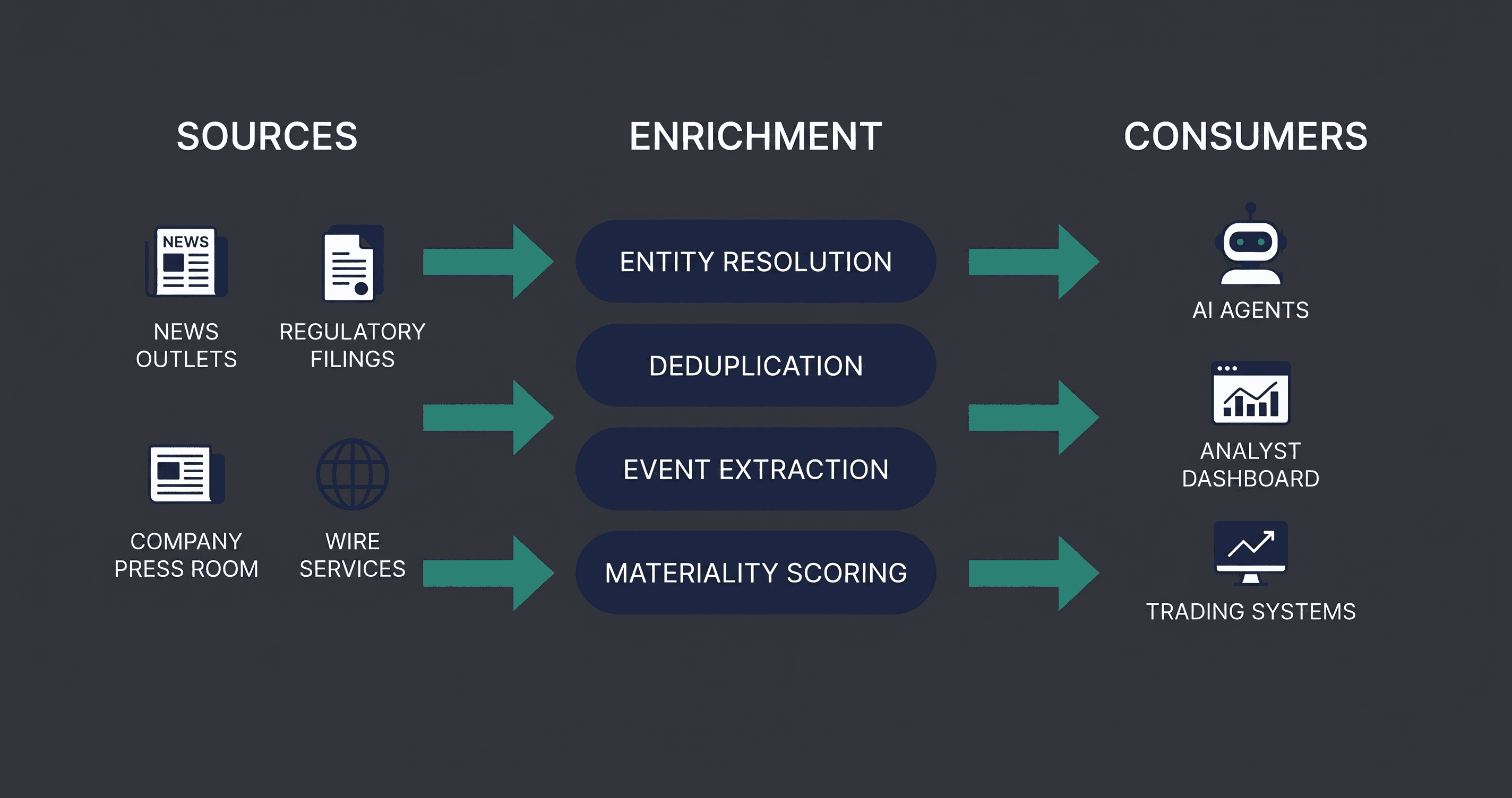
A Company Alerts API is, at the infrastructure layer, three pipelines wired together.
Ingestion. The system pulls from a curated set of sources. Coverage volume varies wildly: some vendors track a few hundred press wires; serious feeds reach 1,000+ global sources spanning regulatory filings, premium publishers, regional and trade press, and verified web. Private company news is noisy, poorly tagged, and costly to get wrong (Akta, 2026), and ingestion design is where most of that noise has to be filtered.
Resolution and enrichment. Each ingested item passes through entity linking, deduplication, classification, sentiment analysis, and impact scoring. The deduplication step is where naive systems fail at scale: a single acquisition announcement gets republished by 40+ outlets, and an unfiltered feed makes 40 alerts look like 40 events. Production systems collapse them into one canonical alert with N source attributions.
Delivery. Consumers retrieve events two ways: pull (GET against an endpoint, often with since and company filters) or push (webhook subscriptions that fire when a new event passes a filter). Push is what makes agentic workflows tractable. Polling every five minutes against 3,000 accounts wastes a budget that webhooks make irrelevant.
A well-designed API exposes all three of these as primitives the consumer can compose. A query like "give me last 24 hours of high-impact negative events for companies in my watchlist, deduplicated, with sentiment and industry tags," should be a single request, not a job that requires four API calls and a reducer.
Where most Company Alerts APIs break
Vendor demos look identical. Production behavior does not. The failure modes worth budgeting against:
Entity collisions. "Delta," "Anthropic" (the AI lab vs. several unrelated entities historically), and any company sharing a name with a common noun produce false positives in volume. APIs without disambiguation against ticker, domain, ownership graph, and known aliases will pollute downstream tables.
Subsidiary blindness. A private equity firm watching a portfolio company will miss the half of events filed under subsidiary or trading names. Owler-style consumer alerting and basic news APIs handle parent entities only. APIs designed for private-markets workflows have to resolve down the corporate tree.
Latency drift on weekends. Many providers run reduced pipelines outside business hours. A regulatory filing on a Friday night becomes a Monday morning alert. For risk and trading teams, that is the gap where the alert was supposed to be useful.
No materiality signal. "High volume" gets confused with "important." A celebrity board appointment and a covenant default both produce 20+ articles. Without a scored materiality field, the consumer team writes the ranking logic, badly, downstream.
Brittle taxonomy. Some APIs let consumers filter on a fixed list of 12 event types. The real world has 50+. A taxonomy that cannot tell apart "Series A" and "secondary tender" forces the consumer to filter on body text, which is the problem the API was supposed to solve.
Source quality opacity. When the same alert appears in Reuters and in an SEO blog farm, both should not carry the same weight. A source-score field, or a curated source whitelist, is what makes a feed safe to put in front of an internal customer.
The teams that ship reliable products on top of a Company Alerts API treat these failure modes as evaluation criteria, not surprises.
Six use cases that justify the integration
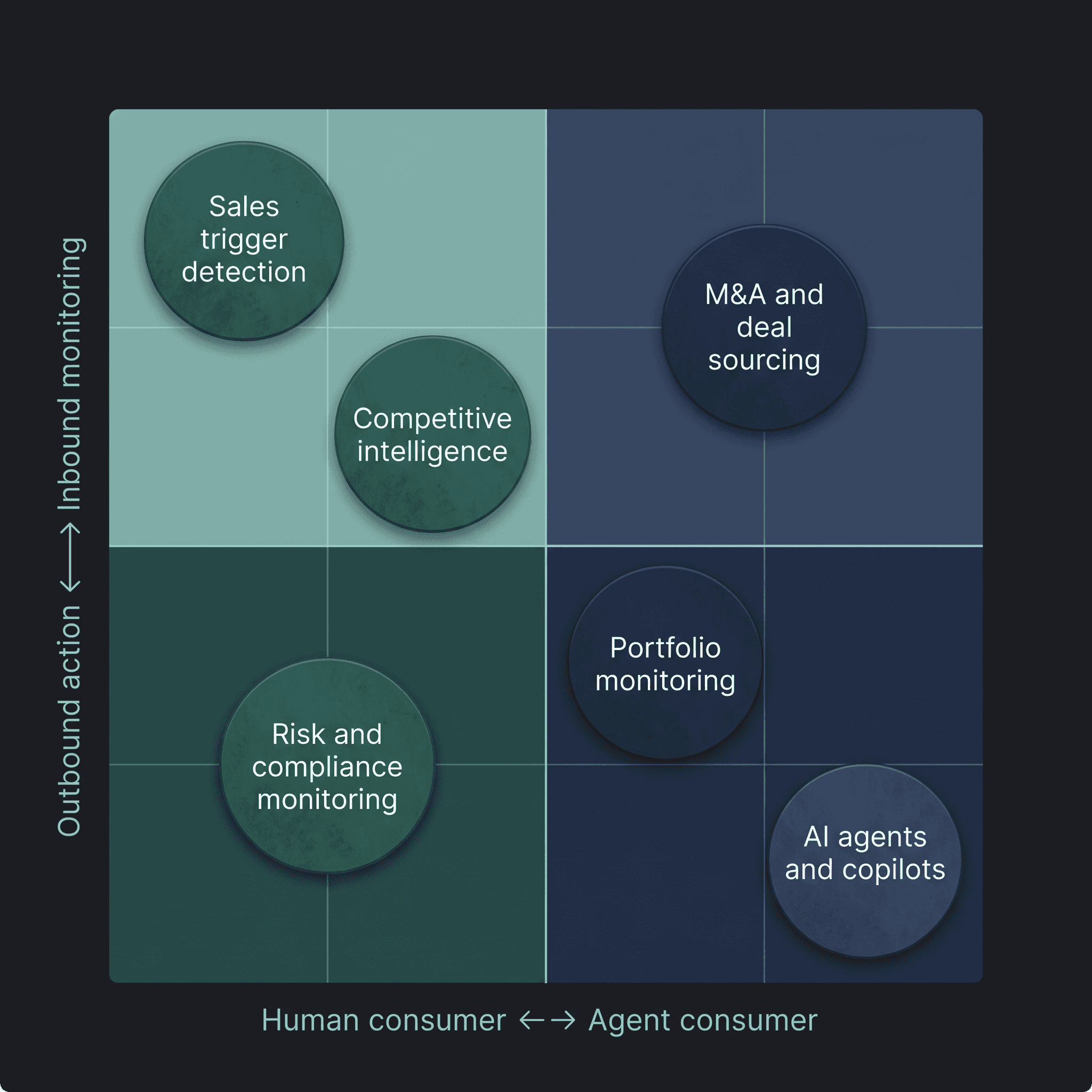
The buyer profile is dual. Developers integrate the API; analysts, traders, dealmakers, and risk teams consume the output. The strongest patterns:
1. Sales trigger detection. Generic outreach is the exact behavior buyers reject. 73% of B2B buyers actively avoid suppliers who send irrelevant outreach (Gartner, 2025). Routing a "new VP of Engineering hired" or "Series C closed" alert to the rep covering that account, with the sentence the alert came from, converts at multiples of cold sequence open rates because the message is timed to the event. Trigger-event signals are the highest-converting outbound input category in modern GTM.
2. M&A and deal sourcing. Corporate development and PE teams use alert APIs to monitor a curated universe (sector, geography, size band) for "founder departure," "down round," "growth-stage funding," and "secondary activity" signals. A sourcing agent pulling the day's alerts, scoring them against an investment thesis, and writing into the deal pipeline replaces what used to be a Monday-morning analyst loop.
3. Risk and compliance monitoring. KYB, sanctions, adverse media, ESG screening, and counterparty risk all run on the same primitive: a continuous watch on a list of legal entities for material negative events. Enrichment matters more here than anywhere else. A "negative" event on a tier-1 supplier with high materiality should escalate; a low-materiality negative event on the same supplier should not.
4. Competitive intelligence. Product and strategy teams track competitor product launches, pricing changes, executive moves, and earnings commentary as the live equivalent of a battlecard. Routing those alerts into a shared Slack channel or a competitive-intel agent that summarizes weekly is the most common 200-line integration anyone writes against a Company Alerts API.
5. Portfolio monitoring. Asset managers, VC partners, and ops teams watching 50–500 holdings need event-level granularity, not headline volume. Entity resolution is the constraint: "Resolves across subsidiaries and trading names automatically. We stopped missing stories on portfolio companies because of naming variations," (Yohei Nakajima, Partner at Untapped Capital, citing Akta).
6. AI agents and copilots. This is the consumer that did not exist when most news APIs were designed. Research agents, investment copilots, and internal Q&A bots retrieve structured event data on a per-question basis. The shape they want is JSON with rich metadata, not a feed they have to parse. A research agent asked "what's happened at Nvidia in the last 14 days" should be able to retrieve a typed list with sentiment and impact already computed, ranked, and deduplicated.
How to evaluate a Company Alerts API
The vendor comparison gets cleaner when you score against the actual production needs.
Entity resolution coverage. Ask for the total count of resolvable entities, the share that are private, and the handling of subsidiaries and trading names. A vendor that resolves only public tickers is solving a 1990s problem.
Source coverage and quality. Total source count is a vanity metric. The right question: which Tier-1 sources, which regulatory feeds, which regional press, and what is the source whitelist? A 50,000-source feed dominated by aggregators is worse than a 1,200-source feed curated for credibility.
Event taxonomy depth. Count the typed event categories. Anything below 25 is shallow. Ask whether the taxonomy is open (can you define a custom type via endpoint configuration) or fixed.
Enrichment fields per alert. At minimum: event type, primary/secondary industry, country, sentiment, materiality or newsworthiness score, source attribution, and original language. Anything missing is a field your team will compute downstream.
Latency profile. Median latency from publication to API availability, and the P95. Ask for the weekend behavior. A median of three minutes with a P95 of two hours is a different product than a median of three minutes with a P95 of seven minutes.
Delivery options. REST is table stakes. Webhook subscriptions, with HMAC signature verification and retry semantics, separate production-grade vendors from prototypes. Ask for a sample payload and the dedup guarantee.
Customization. Can you define your own endpoint with the exact payload structure you need, or are you stuck with the vendor's default schema? Custom endpoints are what let a single API serve a sales-trigger product and a risk-monitoring product without forking the integration.
Pricing model. Per-request, per-credit, per-monitored-entity, or flat-rate. The right model depends on your access pattern. A high-frequency agent that issues 50,000 small requests a day is mispriced on a per-entity plan. A risk team watching 800 entities with low query volume is mispriced on per-request.
Compliance posture. SOC 2 Type II at minimum if the consumer is in financial services, healthcare, or regulated B2B. The actual question: do you have an active report and can you share it.
Use this list as the spec. The vendors who fail half of it eliminate themselves.
Implementation pattern: from pull to push
A typical first integration looks like a polling loop against the news endpoint, filtered by company. That works for development. Production wants webhooks.
Here is a minimal pull pattern against Akta's company news endpoint, written for a sales-trigger workflow:
python sample
The same logic, moved to a push model, eliminates the polling cost and tightens the SLA. The consumer side becomes a single endpoint that receives signed POST requests, verifies the HMAC, idempotency-checks the event ID, and routes. The vendor side handles fan-out, retries, and at-least-once delivery. For agentic workflows in particular, the push pattern is what lets the agent stay idle until something material happens.
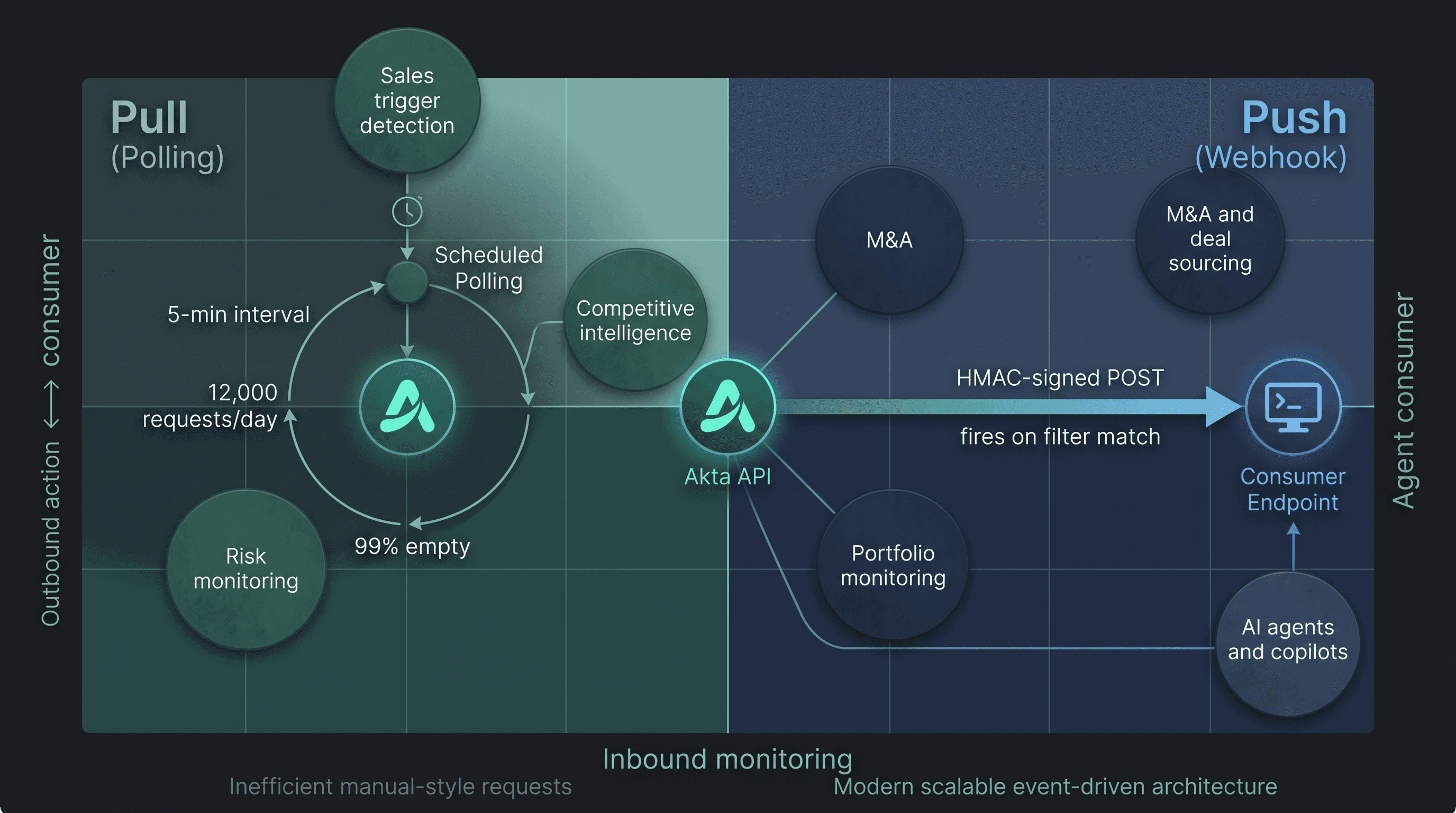
The deeper integration question is not pull versus push. It is whether your stack treats alerts as transient notifications or as durable records. Alerts you store, index, and replay against new questions are an asset. Alerts that vanish after they fire are operational telemetry. The difference is what an AI workflow needs from the layer above the API.
FAQ
What is a Company Alerts API?
A Company Alerts API is a programmatic endpoint that delivers structured, real-time notifications about business events at named companies, such as funding rounds, leadership changes, M&A, layoffs, regulatory filings, lawsuits, and material news. Each alert is entity-resolved and enriched with metadata (event type, sentiment, industry, impact score) so it can be filtered, ranked, and acted on by downstream systems or AI agents.
How is a Company Alerts API different from a news API?
A general news API returns articles matched to keywords. A Company Alerts API operates at the entity layer: every event is linked to a canonical company record, deduplicated across sources, typed by event category, and scored for materiality. The unit of value is the resolved event, not the article. That difference is what makes the output usable for sales triggers, risk monitoring, deal sourcing, and AI agents.
What kinds of events can a Company Alerts API track?
Typical event categories include M&A, funding rounds, leadership and board changes, layoffs and hiring surges, product launches, partnerships, regulatory filings, lawsuits and litigation, earnings, secondary market transactions, and material adverse news. Modern APIs expose 25 to 50+ typed categories and let consumers filter on combinations of type, industry, geography, sentiment, and impact score.
Does a Company Alerts API support webhooks?
Most production-grade Company Alerts APIs support both REST pull and webhook push delivery. Webhooks fire on a subscribed event filter (for example, "high-impact negative events for any company in this watchlist") and deliver a signed JSON payload to a consumer endpoint. Webhook delivery typically includes HMAC verification, retries on failure, and at-least-once semantics, which together make agentic and event-driven architectures practical.
How accurate is entity resolution in a Company Alerts API?
Accuracy depends on the underlying knowledge graph. Public-company resolution against tickers is largely solved. Private-company resolution is harder because companies share names, rename frequently, and operate under multiple trading names and subsidiaries. APIs that resolve across parent companies, subsidiaries, and trading names (Akta covers 20M+ such entities, 2026) materially reduce both false positives and missed alerts compared to keyword-match systems.
What does a Company Alerts API cost?
Pricing falls into three models: per-request or per-credit (best for variable-volume developer use), per-monitored-entity (best for fixed-watchlist risk and portfolio monitoring), and flat-rate enterprise (best for high-volume agentic or product integrations). Self-serve plans typically start at $0 to $200 per month; enterprise contracts vary by source coverage, customization, and SLA. Verify the cost per actually-useful alert, not the headline rate.
Can AI agents use a Company Alerts API directly?
Yes. Modern Company Alerts APIs are designed for both human consumers and autonomous agents. Structured JSON output, deterministic schemas, deduplicated events, and impact scoring let an agent retrieve, filter, and act on alerts without parsing unstructured text. This is the pattern behind agentic sales, research, risk, and deal-sourcing workflows in 2026.